

Revenue Leakage in Hotels: Why Your Rates Are Being Undercut (and What You Can Do About It)
Ever looked up your own hotel… and found it cheaper somewhere else?
You’re on top of your pricing and it looks good. But then a guest calls and says “I found your hotel for £30 less online.”
That moment is what we call revenue leakage. In simple terms, it’s when your rooms are being sold at a lower rate than you intended. And more often than not, it’s happening somewhere in your distribution setup rather than your pricing itself.
So where is the problem actually coming from?
There’s a tendency to say: “It’s not the OTAs, it’s the wholesalers.” That’s partly true—but it doesn’t tell the whole story.
Most leakage does start upstream, usually with discounted or “fenced” rates that were never meant to be widely available. But once those rates surface on an OTA, that’s where the damage is done because at that point that’s what the guest sees, that’s what they compare against your direct price, and that’s what wins the booking.
So yes, the source might sit elsewhere, but OTAs are very much part of how leakage plays out in the real world.
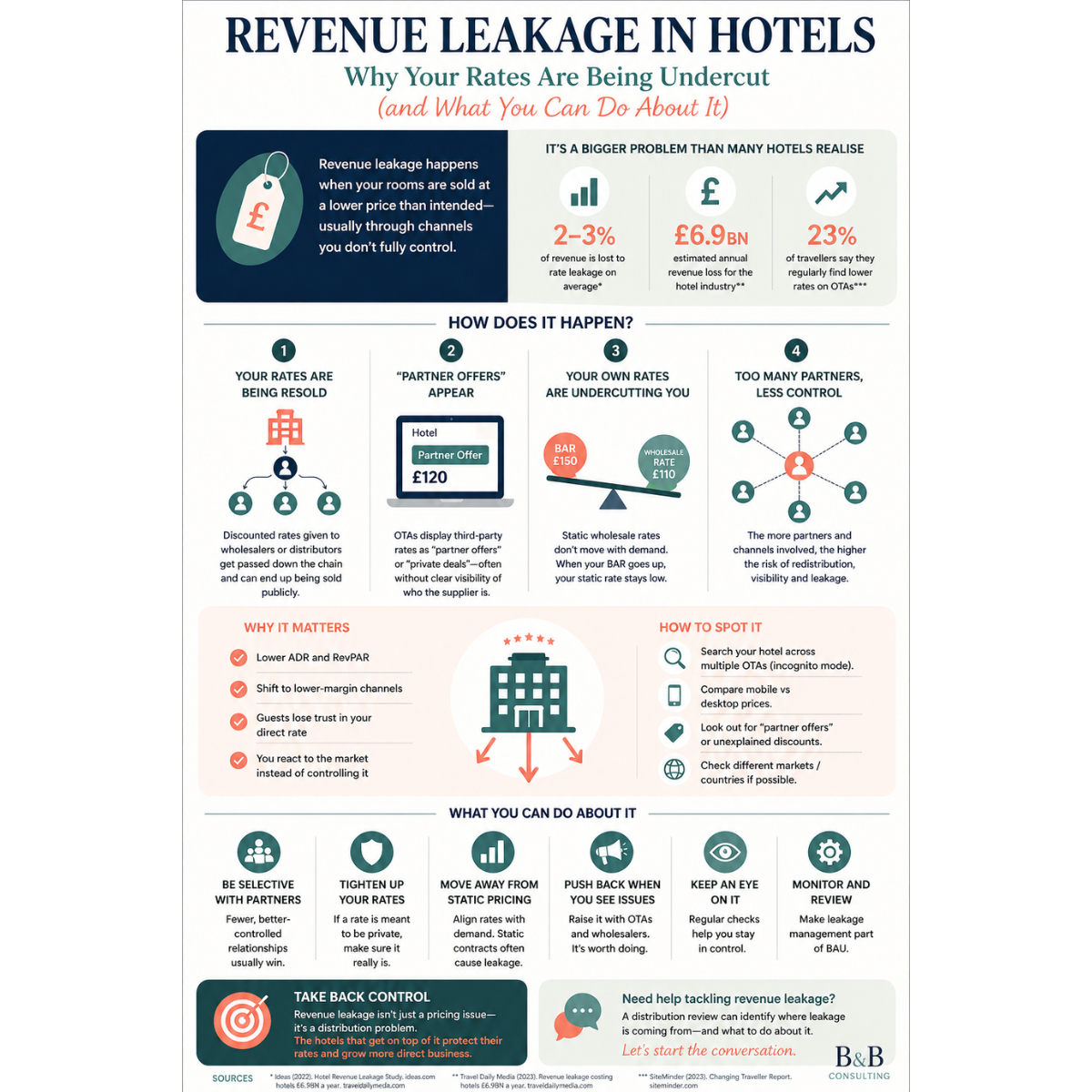
The most common ways revenue leakage happens
In most cases revenue leakage comes from a few familiar places:
Wholesale rates getting out into the wild
You agree a discounted rate with a partner—maybe for packages or specific markets. Somewhere down the line, that rate gets passed on again… and eventually ends up being sold publicly. What was meant to be controlled isn’t controlled anymore.
“Partner offers” and hidden suppliers
You’ll often see labels like “Partner Offer” on Booking.com. These are usually third-party rates being fed into the platform. The difficulty is that you can’t easily see who’s behind them, which makes fixing the issue harder than it should be.
Static rates in a dynamic market
This one catches a lot of hotels out. Your BAR moves with demand, but your wholesale rates don’t. When demand spikes, those older contracted rates suddenly look very cheap—and undercut you without anyone technically doing anything wrong.
Too many routes to market
More partners can feel like more opportunity. In practice, it often just means less control. The more places your rates go, the harder it becomes to manage where they end up.
Why it matters (more than just a few pounds per booking)
The odd cheaper rate here and there might not feel like a big deal, but but it rarely stays as “the odd one”. Over time you’ll notice lower rates getting picked up and prioritised by OTAs, guests start to lose trust in direct pricing and bookings drift towards lower-margin channels.
How to spot if it’s happening to you
You can perform a quick chesck yourself to see if this issue is affecting you. First, search for your hotel across a couple of OTAs. Try it on mobile and desktop. If possible, check prices as if you were searching from another country, as rates can vary by market. If you’re consistently seeing lower prices than your own, especially with “partner” labels attached, you’re almost certainly dealing with rate leakage.
What can you realistically do about it?
There’s no single silver bullet, but there are a few areas that tend to make the biggest difference.
Take a hard look at your partners
Not every relationship is worth having. A smaller number of well-managed partners is often far more effective than a long tail you can’t fully control.
Be stricter with “private” rates
If a rate is meant to be closed or packaged, it needs to stay that way. If it’s visible, even indirectly, assume it can leak.
Rethink static contracts
Where possible, move towards more dynamic pricing structures. Fixed rates are one of the most common sources of unintentional undercutting.
Don’t be afraid to challenge it
If you see an issue, raise it. With the OTA, with the wholesaler, with whoever you can identify. It’s not always a quick fix, but ignoring it rarely helps.
Keep checking
This isn’t something you solve once and forget. A bit of regular monitoring goes a long way.
Final thought
Revenue leakage sits in the murky space between pricing and distribution. It’s not always obvious where it starts—but it’s very visible where it ends up, and the effects have a direct and corrosive impact on your business and income.
If you’ve ever wondered why your hotel is cheaper somewhere else, you’re not alone. The important bit is knowing what’s behind it—and doing something about it. By now you have the tools to identify if this issue affects you and what you can do about it.
If you’re seeing unexplained undercutting and want a clearer picture of what’s going on, it’s worth taking a proper look at your distribution setup. A quick review can usually pinpoint where leakage is coming from.